
Encrypted XIP using BEE (Bus Encryption Engine)#
This document extends the documentation of MCUBoot and encrypted XIP in OTA examples and provides an additional information related to the BEE module.
1. Introduction#
BEE is specific for RT10xx (except RT1010) and supports up to two separate regions using two separate AES keys. In the ota examples, BEE region 1 is used for encrypting the execution slot and BEE region 0 is reserved for a bootloader.
BEE configuration blocks are organized as EPRDB (Encrypted Protection Region Descriptor Block), where the EPRDB is encrypted using AES-CBC mode with AES key and IV located in KIB (Key Info Block). The KIB is encrypted as EKIB (Encrypted KIB) using a key provisioned by the user. Each BEE region has its PRDB/KIB pair.
The EKIB is decrypted by a key based on selection in BEE_KEYn_SEL fuse:
Software key
default value in
BEE_KEYn_SELevaluating BEE without fusing the device
SW-GP2
fused by user and typically used for offline encryption
limited funcionality due hardware bugs, see errata
not supported in the examples
OTPMK
provisioned by NXP in factory
unique per device instance - prevents image cloning
recommended
Following image shows complete metadata structure used for devices with BEE.
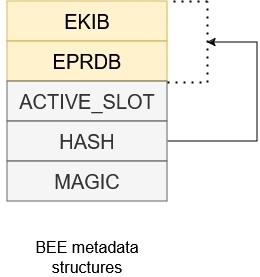
Firmware in execution slot is de/encrypted using AES-CTR combining nonce extracted from PRDB and this device key. The extension automatically detects device key by evaluating BEE_KEYn_SEL fuse.
The whole BEE initialization and encryption metadata handling is resolved in module encrypted_xip_platform_bee.c.
Additional information can be found in Security Reference Manual of target device and in application notes AN12800, AN12852 and AN12901.