
MCUXpresso SDK Release Notes#
Development tools#
The MCUXpresso SDK was tested with following development tools. Same versions or above are recommended.
IAR Embedded Workbench for Arm, version is 9.70.4
Keil MDK, version is 5.43a
MCUXpresso for VS Code v26.06
GCC Arm Embedded Toolchain 14.2.x
Supported development systems#
This release supports board and devices listed in following table. The board and devices in bold were tested in this release.
Development boards |
MCU devices |
|---|---|
FRDM-MCXW23 |
MCXW235AIHNAR, MCXW235AIUKAR, MCXW235BIHNAR, |
MCUXpresso SDK release package#
The MCUXpresso SDK release package content is aligned with the silicon subfamily it supports. This includes the boards, CMSIS, devices, middleware, and RTOS support.
Device support#
The device folder contains the whole software enablement available for the specific System-on-Chip (SoC) subfamily. This folder includes clock-specific implementation, device register header files, device register feature header files, and the system configuration source files. Included with the standard SoC support are folders containing peripheral drivers, toolchain support, and a standard debug console. The device-specific header files provide a direct access to the microcontroller peripheral registers. The device header file provides an overall SoC memory mapped register definition. The folder also includes the feature header file for each peripheral on the microcontroller. The toolchain folder contains the startup code and linker files for each supported toolchain. The startup code efficiently transfers the code execution to the main() function.
Board support#
The boards folder provides the board-specific demo applications, driver examples, and middleware examples.
Demo application and other examples#
The demo applications demonstrate the usage of the peripheral drivers to achieve a system level solution. Each demo application contains a readme file that describes the operation of the demo and required setup steps. The driver examples demonstrate the capabilities of the peripheral drivers. Each example implements a common use case to help demonstrate the driver functionality.
RTOS#
FreeRTOS#
Real-time operating system for microcontrollers from Amazon
Middleware#
CMSIS DSP Library#
The MCUXpresso SDK is shipped with the standard CMSIS development pack, including the prebuilt libraries.
mbedTLS#
mbedtls SSL/TLS library v3.x
TF-M#
Trusted Firmware - M Library
PSA Test Suite#
Arm Platform Security Architecture Test Suite
Bluetooth LE Host Stack and Applications#
The Bluetooth LE Host Stack component provides an implementation for a Bluetooth 6.0 mandatory and some optional, proprietary, and experimental features. The Bluetooth LE Host Stack component provides application examples, services, and profiles.
Main features supported:
Automotive Compliance
MISRA Compliance
HIS CCM <= 20
Advanced Secure Mode
Enhanced ATT
GATT Caching
GCC Libraries
IAR Libraries
Bluetooth LE Peripheral Libraries
Bluetooth LE Central Libraries
Bluetooth LE Full Host Features Libraries
Bluetooth LE Host Optional Features Libraries
Bluetooth LE Host Mandatory Features Libraries
BareMetal and FreeRTOS Support
Full Privacy Support
NCP Mode - FSCI Application
Enhanced Notifications
Dynamic Database
OTA Support - Sample Applications
Decision based Advertising Filtering (DBAF)
Advertising Coding Selection (ACS)
Periodic Advertising with Responses (PAwR)
Encrypted Advertising Data (EAD)
Monitoring Advertisers - Experimental feature
Randomized RPA - Experimental feature
Intrusion Detection System (IDS) - Experimental feature
Note: The CDE(Complex-domain Distance Estimation) algorithm is an experimental feature intended only for testing purposes. It is not maintained and must not be included in production environments.
Parent topic:Wireless connectivity middleware overview
Connectivity framework#
The Connectivity Framework is a software component that provides hardware abstraction modules to the upper layer connectivity stacks and components. It also provides a list of services and APIs (see Supported services). The Connectivity Framework modules are located in the middleware\wireless\framework SDK folder.
Supported services#
FSCI - Framework Serial Communication Interface
FunctionLib - Common function library utilities
HWParameter - Hardware parameter management
LowPower - Low power mode management
ModuleInfo - Module information and versioning
NVS - Non-Volatile Storage
NVM - Non-Volatile Memory management
OtaSupport - Over-The-Air update support
SecLib_RNG - Security library and Random Number Generator
Sensors - Sensor abstraction layer
SFC - Smart Frequency Calibration
WorkQ - Work queue management
Supported platform#
KW45_MCXW71
KW47_MCXW72
MCXW23
RW61X
RT1060 and RT1170
i.MX RT595s
Advanced features supported on platforms#
KW45_MCXW71#
FRO32K with smart frequency calibration (see SFC)
Power down mode support (for evaluation only)
KW47_MCXW72#
FRO32K with smart frequency calibration (see SFC)
Power down mode support (for evaluation only)
Crystal 32M trimming with temperature
Debug module for NBU
Extended NBU support with SecLib and pseudo RNG support
Bluetooth Synopsys Controller#
Main features supported:
All roles that the Bluetooth specification specifies:
Broadcaster
Observer
Peripheral
Central
Up to 4 simultaneous connections supported
Bluetooth Low Energy features:
Device privacy and network privacy modes (version 5.0)
Advertising extension PDUs (version 5.0)
Anonymous device address type (version 5.0)
Up to 2 Mbps data rate (version 5.0)
Long range (version 5.0)
High-duty cycle, nonconnectable advertising (version 5.0)
Channel selection algorithm #2 (version 5.0)
High output power (version 5.0)
Advertising channel index (version 5.1)
Periodic advertising sync transfer (PAST) (version 5.1)
Supports LE power control feature (version 5.2)
Device filtering through programmable size white lists
Direct test mode
RF antenna: 50 Ω single-ended
RF receiver characteristics:
Sensitivity −94 dBm in Bluetooth Low Energy 2 Mbps
Sensitivity −97 dBm in Bluetooth Low Energy 1 Mbps
Sensitivity −100 dBm in Bluetooth Low Energy 500 kbps
Sensitivity −102 dBm in Bluetooth Low Energy 125 kbps
Accurate RSSI measurement with ±3 dB accuracy
Flexible RF transmitter level configurability:
TX mode 1 (TXM1): Range from −31 dBm to +2 dBm when VDD_RF exceeds 1.1 V
TX mode 2 (TXM2): Range from −28 dBm to +6 dBm when VDD_RF exceeds 1.7 V
LittleFS#
LittleFS filesystem stack
Release contents#
Provides an overview of the MCUXpresso SDK release package contents and locations.
Deliverable |
Location |
|---|---|
Boards |
INSTALL_DIR/boards |
Demo Applications |
INSTALL_DIR/boards/<board_name>/demo_apps |
Driver Examples |
INSTALL_DIR/boards/<board_name>/driver_examples |
eIQ examples |
INSTALL_DIR/boards/<board_name>/eiq_examples |
Board Project Template for MCUXpresso IDE NPW |
INSTALL_DIR/boards/<board_name>/project_template |
Driver, SoC header files, extension header files and feature header files, utilities |
INSTALL_DIR/devices/<device_name> |
CMSIS drivers |
INSTALL_DIR/devices/<device_name>/cmsis_drivers |
Peripheral drivers |
INSTALL_DIR/devices/<device_name>/drivers |
Toolchain linker files and startup code |
INSTALL_DIR/devices/<device_name>/<toolchain_name> |
Utilities such as debug console |
INSTALL_DIR/devices/<device_name>/utilities |
Device Project Template for MCUXpresso IDE NPW |
INSTALL_DIR/devices/<device_name>/project_template |
CMSIS Arm Cortex-M header files, DSP library source |
INSTALL_DIR/CMSIS |
Components and board device drivers |
INSTALL_DIR/components |
RTOS |
INSTALL_DIR/rtos |
Release Notes, Getting Started Document and other documents |
INSTALL_DIR/docs |
Tools such as shared cmake files |
INSTALL_DIR/tools |
Middleware |
INSTALL_DIR/middleware |
What is new#
The following changes have been implemented compared to the previous SDK release version (26.03.00-pvw2).
Bluetooth Synopsys controller
Fix scan response not always sent when filtering duplicates is enabled
Avoid network privacy if Peer IRK is all zero
Take also SID into account when adding a unique entry in the periodic advertiser list
Reject peer random static addresses in the resolving list when it does not contain 11 as MSb
Bluetooth LE
Major Changes
Added support for switching to the coded PHY mode.
Minor Changes
[PSA] Added the project_segment Kconfig option to enable selection of an optimized PSA configuration for Bluetooth LE applications.
Connectivity framework
Major Changes
[NVM] Enhanced robustness of NVM MIT (Meta Information Tag) operations with improved validation and error handling. Added checksum validation feature controlled by
gNvmMetaCheckSum_dcompilation switch. Systematically validates MIT fields before use and triggers page switch if corruption detected. FixedmNvTableSizeInFlashtracking when table entries are modified. RefactoredNvWriteRecord()and addedNvModuleSwitchPage()for better ECC fault handling. AddedNvSetChecksumEnable()API to control feature at runtime. The feature is disabled by default.[SecLib_RNG] Refactored SecLib mutex declaration and made Lock/Unlock functions public. Changed return type from
osa_status_ttosecResultType_tfor SecLib mutex functions and moved mutex Lock/Unlock function declarations to SecLib.h.[SecLib_RNG][PSA] Activated PSA opaque execution with s200 and its secure key storage. Switched from PSA transparent mode to opaque mode for all functions except
CMAC_LsbFirstInput()which is currently not supported in opaque version. OptimizedSecLib_psa_configto fully accelerate allPSA_WANT_KEY_TYPE_ECC_KEY_PAIRfunctions.
Minor Changes
[wireless_mcu][ble] Refactored
PLATFORM_SetBleMaxTxPower()API moved from platform file tofwk_platform_ble.cfor Zephyr compatibility.[wireless_mcu] Modified
PLATFORM_GetBDAddr()to return consistent address across calls whengPlatformUseHwParameter_dis disabled.[Common] Enhanced external flash API with C++ compatibility by adding extern “C” guards.
[platform] Added platform abstraction macros
PLATFORM_GET_IPSR,PLATFORM_SET_INT_MASK, andPLATFORM_CLEAR_INT_MASKto allow platform-specific customization of IPSR read and interrupt mask functions while maintaining backward compatibility.
Bug Fixes
[OTA][Coverity] Sanitized the
pImageOffsetparameter in OTA functions to avoid possible overflow.[SecLib] Fixed multiplication buffer pointer initialization for segmented ECDH operations. Fixed EC P256 multistep operations using SW legacy library. Fixed
ECDH_P256_ComputeDhKeySeg()andECDH_P256_GenerateKeysSeg()argument checking across SecLib variants. FixedSecLib_AES_CMAC_PRF_128()behavior for SecLib sss variant that tolerated VK length to be 0. Removed unreachable code fromSecLib_HMAC_SHA256_Finish().[NVM] Fixed initialization procedure in
InitNVMConfig()to validatestart_addrandpartition_size.[SecLib_RNG] Corrected copyright header in
seclib.c.[MISRA] Various MISRA and CERT-C compliance fixes in NVM module.
Known issues#
This section lists the known issues, limitations, and/or workarounds.
Limitations when creating a new FreeRTOS-based C/C++ project#
Due to the missing component dependencies definition, there are several limitations when creating a new FreeRTOS-based C/C++ project in MCUXpresso IDE. When the FreeRTOS kernel component is selected (under Operating Systems/RTOS/Core menu), you must manually select the FreeRTOS cm33 non trustzone port component (under Middleware/RTOS menu) for projects without TrustZone. For FreeRTOS TrustZone projects creation, the support is not ready.
HCI black box application for MCXW23 – Insufficient stack size on iar and armclang#
hci_bb_mcxw23 binaries compiled using iar or armclang toolchain have an insufficient stack size and can crash when issuing HCI commands requiring a bigger stack size like LE_Extended_Advertising_Enable. Binaries compiled with gcc don’t suffer from this issue.
Wireless UART application – Bluetooth Low Energy advertising and connection loss issue#
When using the Wireless UART application with default settings, functionality is as expected. However, the following issue occurs when the Bluetooth Low Energy advertising interval is set to 20 milliseconds and the connection interval is set to 7.5 milliseconds: After two devices establish a connection, the central device fails to start advertising to a third device after a button press. The HCI command to start advertising returns success, but the device does not transmit any advertising packets. Additionally, the supervision timeout causes the existing connection to drop unexpectedly.
Bluetooth Synopsys Controller#
Stability observation during extended testing The llhwc_set_adv_param function shows unexpected behavior during extended sequences of link layer tests, typically after 1.5 hours of continuous execution without a hardware reset.
This rare behavior occurs only under specific test conditions.
The behavior relates to the extended advertising feature.
This behavior does not impact regular usage scenarios.
Health care iot peripheral freestanding application creation issue#
The CMakeList.txt file to ensure correct application files work with different health_care_iot_peripheral applications (bm/freertos/threadx). The project now includes a hciot_peripheral.cmake file that contains common application files. This modification creates problems when you build a freestanding application without the –bf option.
without –bf option:
The application related files are no longer part of the project creation. The project uses the files part of the repo
This can be resolved by using the –bf option.
with –bf option:
the application files are placed in the
directory and in the root project directory. And you will find 2x main.c (with different content), one in the project root and one in the directory. Only the version in the
directory is correct, and you can safely remove the main.c in the project root directory.
Compilation if failing in case of the threadx variant
Safety.c is present twice in the project. The version in the project root directory is the correct version, You need to remove the safety.c in the
directory. Together with the removal of the safety.c file in the
directory you also need to modify the /board_files.cmake and remove safety.c from the mcu_add_source() (line 110).
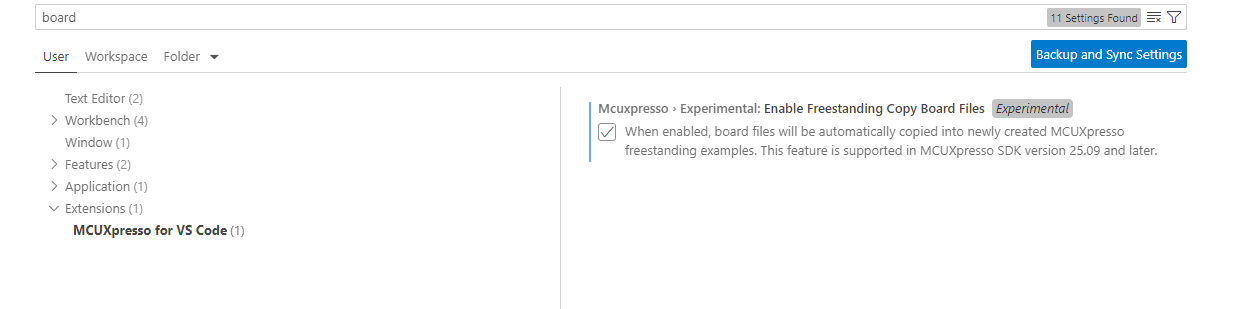
The MCUXpresso plugin for VS Code allows you to create a freestanding application that includes board files. Configure this feature in the MCUXpresso for VS Code settings.
Average current consumption#
Compared to SDK release 26.03.00, the average current consumption on MCX W23 may present limited increase depending on how frequently the device wakes up. For example, during an active Bluetooth LE connection the average current may increase by around 5%, with the general average being lower based on wakeup and connection frequency.